
Corbin Stone Diaz
Corbin Stone Diaz
Research Technician
@ Northwestern University
Past Research
Honors Thesis: Modeling Zebrafish Tail Locomotion Using Biologically Relevant Dynamics (Aug 2025 - July 2026)
Department of Neurobiology, Department of Data Science & Statistics
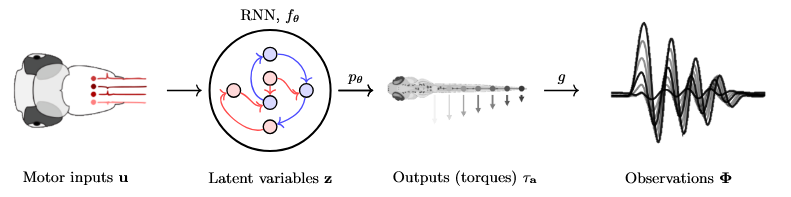
As part of my senior thesis, I researched under Prof. James E. Fitzgerald and Prof. Tirtho Biswas in the Fitzgerald lab on modeling zebrafish tail locomotion using biologically relevant dynamics.
Computational neuroscience and machine learning are heavily connected, and hence tend to use similar models and techniques. But while machine learning focuses mostly on “making the best model” to replicate learning and behavior, neuroscience aims to understand what that model actually is. Biological relevance has become lost in the field of machine learning and AI, which may hinder our ability to learn about how the brain actually works.
How can we model behavior like zebrafish tail locomotion in a way that is actually biologically plausible? How do we incorporate relevant biomechanics into our models? And most importantly, what can we learn from such models on how and why the neural circuitry is designed in such a way? Our research aims to answer these questions using both standard and cutting-edge machine learning tools on zebrafish swim bouts, incorporating both neuronal RNNs and physical dynamics. Our methods use a combination of regression analysis, control theory, and variational inference to infer possible parametrics and performance compared to real data.
As part of a talk to the Northwestern Undergraduate Math Society, I presented a preview of my research put more into the context of an introduction to computational neuroscience. It can viewed below.
IS2TA: Mathematical Techniques to Signal Recovery & Reconstruction (June 2025 - Aug 2025 and June 2026 - Aug 2026)
Department of Earth Environmental and Planetary Science
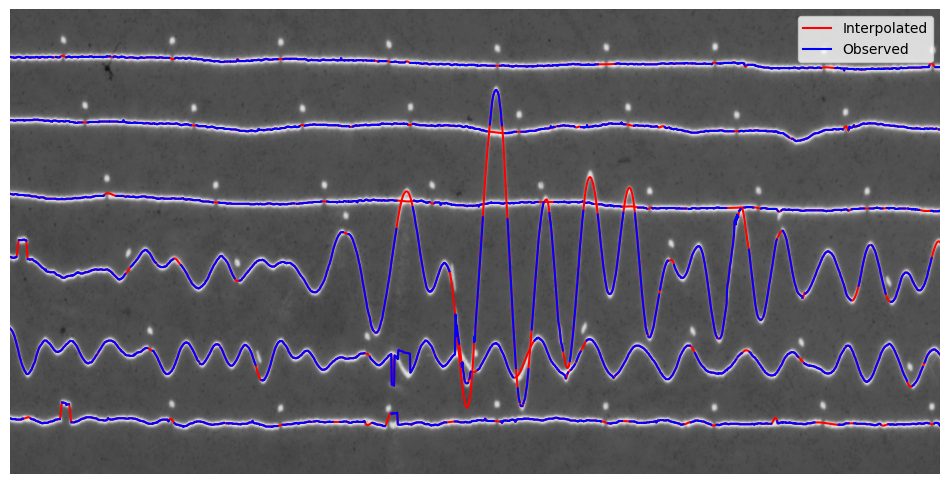
In the summer of 2025, I researched under the mentorship of Suzan van der Lee on signal recovery of inaccurately digitized seismograms through a mathematical lens. The goal was to develop a mathematical technique that could take poorly scanned analogue signals and recover the signal from inaccurate reconstructions. During this time, I developed IS2TA (Iterative Segment-to-Trace Assignment), an algorithm that could convert geometric data of signals into vectorized data by iteratively assigning and reconstructing each trace. The program worked surprisngly well, and was passed down to the rest of the department to help further improve digitization programs such as SKATE. In the summer of 2026, I worked to help improve the algorithm and evaluate its performance, and detailed my results in a technical report.
Mysterious Infrasound Signals (Aug 2024 - May 2025)
Department of Earth, Environmental and Planetary Science
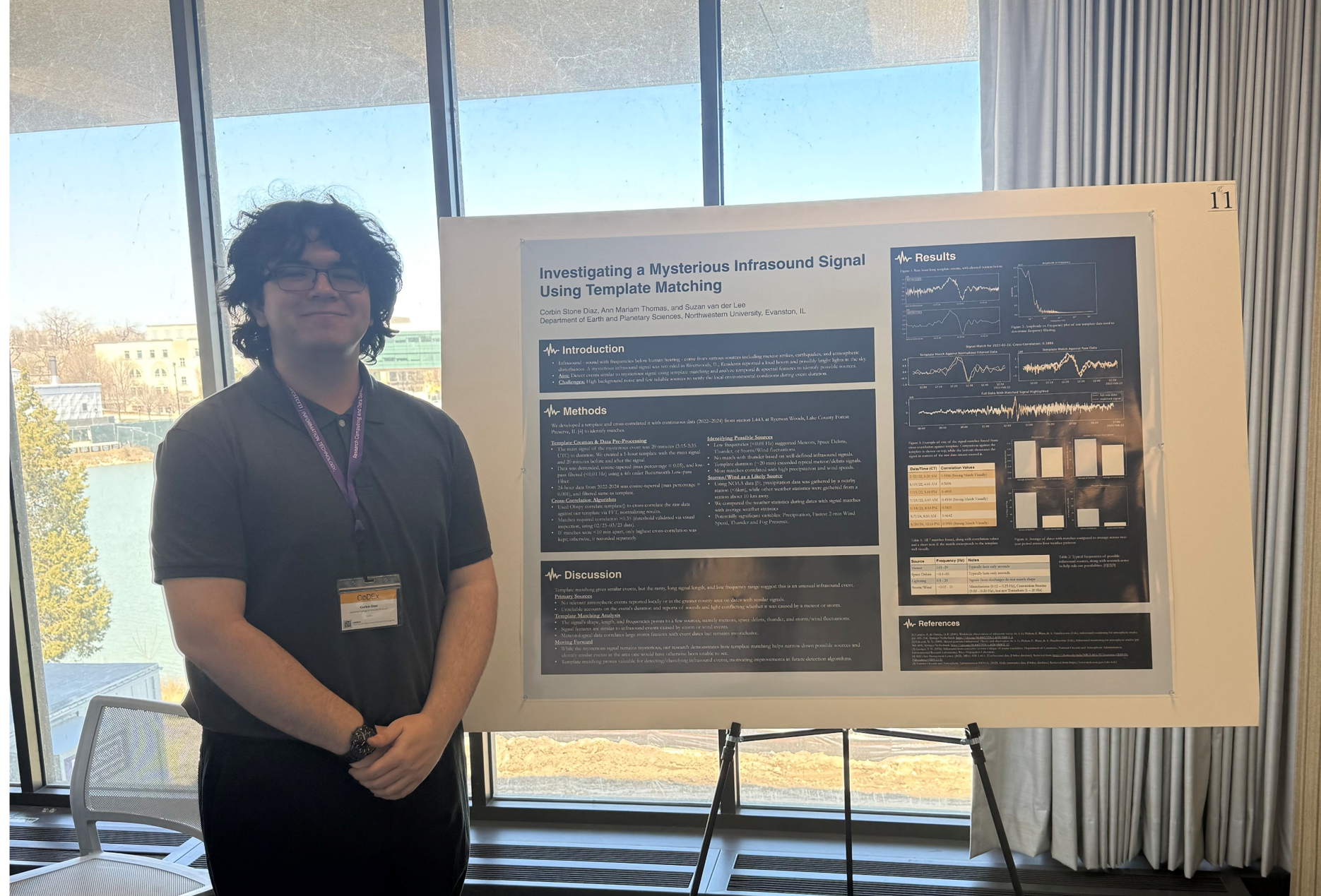
During my junior year at Northwestern, I worked as a research assistant with graduate student Ann Mariam Thomas under Prof. Suzan van der Lee on mysterious infrasound signals. Around March of 2023, a mysterious low boom and bright light was witnessed near a station by Northwestern. The source generated an unusual infrasound event that was never identified… so the obvious question is, what was it? During this project, I used a technique called template matching to compare cross-correlations with several years of past data to narrow down its possible sources. I presented my findings at the 2025 Northwestern CoDEx research symposium poster competition. This poster is included below.